Women Bear Hidden Costs of Mongla Port Expansion
Fariha Jesmin
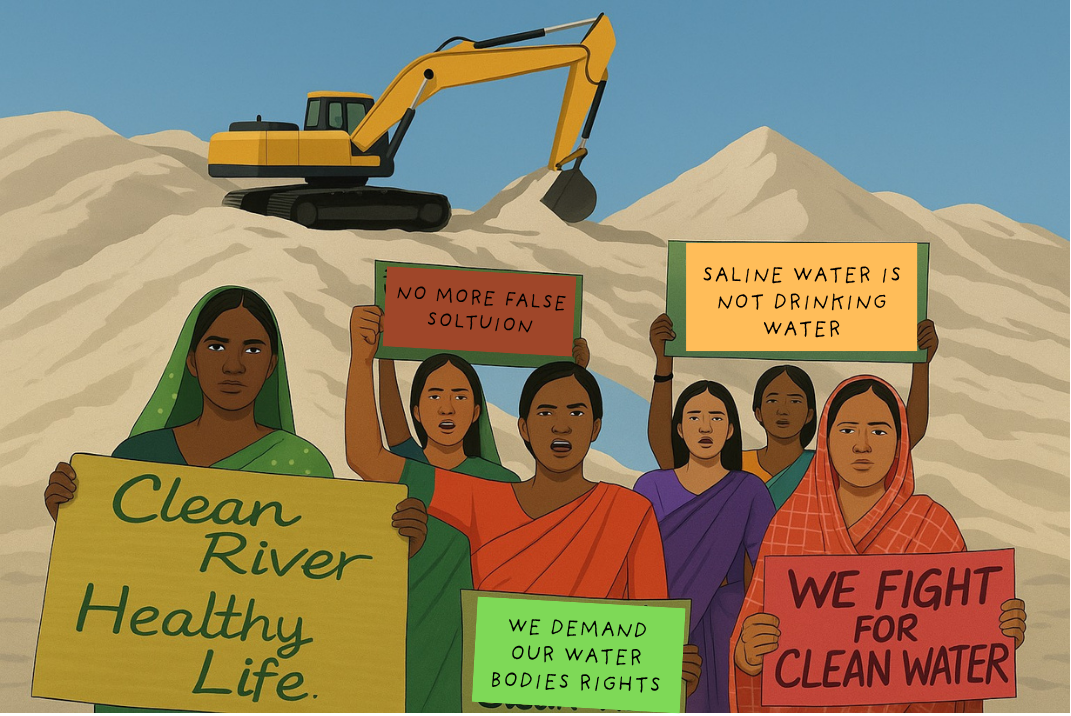
Mongla, Bangladesh — A government-backed dredging project to expand Mongla Port has sparked a crisis along the Pashur River, with women and girls facing the steepest consequences. While the “Inner Bar Dredging Project,” launched in 2021, was intended to boost trade and climate resilience, its fallout has buried farmland, disrupted livelihoods, and exposed families to new risks of violence and displacement.
Farmland Buried Under Sand
More than 700 acres of farmland have been covered with dredged sand and salty silt. Farming, aquaculture, and livestock rearing have ground to a halt. Canals are blocked, fish populations are dwindling, and groundwater is turning saline — leaving families short of food and clean water.
For many households, the loss of productive land has meant immediate hunger and long-term insecurity. Farmers say the sand has made fields unusable, while fishers report declining catches. The environmental disruption has triggered cascading effects across the community.
Women’s Livelihoods Collapse
Women, who depend heavily on homestead farming, small-scale fisheries, and livestock care, have lost their income and independence. “I used to catch 1,500 fish fry per tidal cycle. Now it’s barely 100,” said Rubia, a fisherwoman from North Joymonir Kata Khal. With grazing land gone and ponds contaminated, women are increasingly dependent on male relatives or intermediaries, heightening household tensions and risks of domestic violence.
Manju Mondal, 45, whose husband is chronically ill, once relied on crabs to feed her family. With crab populations decimated, she struggles to meet even basic needs. “We cannot earn. We cannot feed our children,” she said.
Land Rights Undermined
Although many women hold land through inheritance or joint ownership, compensation and acquisition processes are largely negotiated with men. Reports from affected communities describe fraudulent land deals, broken promises, and intimidation once land is filled with sand — eroding women’s property rights and tenure security.
Policy research shows that women in Bangladesh remain at risk of dispossession despite constitutional guarantees of equality. A 2024 study highlights gaps between law and practice in securing women’s land rights (Policy Research: Women Land Rights in Bangladesh: https://badabonsangho.org/wp-content/uploads/2024/04/Policy-research-1-1.pdf). Without gender-sensitive enforcement, women are excluded from consultations and denied fair compensation.
Health and Safety Concerns
Local clinics report rising cases of skin diseases, eye infections, and reproductive health problems linked to sand dumping and saline water. Dr. Md. Shaheen, the Upazila Health and Family Planning Officer, warned that prolonged exposure to contaminated water has led to uterine infections and could increase risks of cervical cancer. Pregnant women face higher risks of complications, while girls are burdened with longer trips to fetch water, exposing them to harassment.
Community health workers say women are experiencing gynecological problems, abnormal discharge, and infections directly linked to saline water use. Children face digestive and skin-related illnesses. These health risks underscore the gendered consequences of environmental disruption.
Climate Justice and Policy Context
The Mongla dredging project is part of Bangladesh’s broader climate and infrastructure agenda. Officials say it aligns with the Bangladesh Delta Plan 2100, a long-term strategy to manage water, land, and climate risks (Bangladesh Delta Plan official site: https://bdp2100kp.gov.bd/). The plan envisions spending 2.5% of GDP on delta-related interventions to ensure resilience.
Similarly, the government has promoted the Blue Economy agenda, which seeks to harness marine resources for sustainable growth (Blue Economy in Bangladesh: Opportunities & Challenges: https://econaturebd.com/blue-economy-in-bangladesh/). Advocates argue that while these policies promise prosperity, they often overlook gendered impacts.
The dredging itself is part of the Inner Bar Channel Project at Mongla Port, approved to increase navigability and allow larger ships to dock (Inner Bar Channel Dredging of Mongla Port resumes: https://www.bssnews.net/district/172055). Officials say the project will strengthen trade routes, but residents insist the social costs are being ignored.
Bangladesh has also advanced climate resilience policies, including infrastructure roadmaps and adaptation strategies. A recent report highlights the need for resilient infrastructure to protect vulnerable communities (Bangladesh’s Climate Policy: Challenges, Actions, and the Road to COP30: https://sanemnet.org/wp-content/uploads/2025/05/Bangladeshs-Climate-Policy-Challenges-Actions-and-the-Road-to-COP30.pdf). Yet in Mongla, resilience has come to mean displacement and insecurity for women.
Voices from the Ground
“The sand is everywhere — in our food, in our eyes, on our bedding,” said Gayetri Ray, a fisherwoman from Joymoni. “Our gardens, trees, and livestock are gone. We cannot earn. We cannot feed our children. We feel unsafe in our own homes.”
Other women describe emotional abuse, verbal intimidation, and physical violence from frustrated male family members. Economic dependency limits their ability to resist coercion or leave unsafe households. Some have faced separation or divorce as men migrate in search of work, leaving women-headed households more exposed to harassment and exploitation.
Girls are also affected, often tasked with long trips to fetch water or fodder, placing them in unsafe areas. Displacement has disrupted schooling, increased unpaid care responsibilities, and raised risks of early marriage and child labor.
Calls for Gender-Sensitive Action
Community leaders and activists argue that the project highlights a broader climate justice failure: those least responsible for climate change are paying the highest social costs. They urge authorities to prioritize women’s safety, enforce land and inheritance rights, and ensure gender-sensitive planning in climate and infrastructure projects.
Without safeguards, women and girls remain the invisible casualties of development. Advocates call for:
- Gender-responsive planning in all climate and infrastructure projects.
- Enforcement of women’s land rights and fair compensation.
- Health protections for women exposed to contaminated water and sand.
- Safe relocation programs for displaced households.
- Participation of women in decision-making processes.
Conclusion
As the dredging project moves toward its extended completion date in 2026, the stories emerging from Mongla raise urgent questions about accountability, resilience, and justice. For women and girls along the Pashur River, development has come at the cost of safety, dignity, and survival.
Bangladesh’s ambitious policies — from the Delta Plan 2100 to the Blue Economy blueprint — promise resilience and prosperity. But unless they integrate gender safeguards, they risk reproducing inequality and violence. The Mongla case is a stark reminder: resilience must be defined not only by economic gain, but by justice, safety, and equality.
“This story has been produced with the support of Earth Journalism network”.
About the Author: Fariha Jesmin is a Programme Manager at Badabon Sangho with a focus on gender justice, climate resilience, and community development. Her work engages closely with women in vulnerable coastal communities, highlighting the intersections of environment, livelihood, and inequality through a feminist lens.
