Reimagining ‘Cinderella’ through a Feminist Lens
Shekh Sadia Akter
Midnight Thought
It has become a bedtime routine that I must tell my niece a fairytale before she falls asleep. Similar to other children, my niece also insists on hearing the same stories over and over rather than new ones. Among her favorites is the story of Cinderella. One night after finishing the story of Cinderella, I found her still awake. Suprisingly, she asked me a question that I had never considered before. She asked: What happened to Cinderella after she married the prince?
That was the moment I began to reimagine Cinderella. As I thought deeply, I realized that perhaps the struggle of Cinderella did not truly end with her marriage. Maybe there is more! I kept wondering – did Cinderella, in fact, find freedom? Or, did she simply step into another form of confinement? The more I pondered, the more it seemed that the marriage was less about love and more about spectacle: the prince dazzled by a gown, a glass slipper, and beauty measured by convention rather than character. If he truly admired Cinderella for herself, there was no need of the trail with the missing slipper. He would have recognized her at first sight in the morning light.
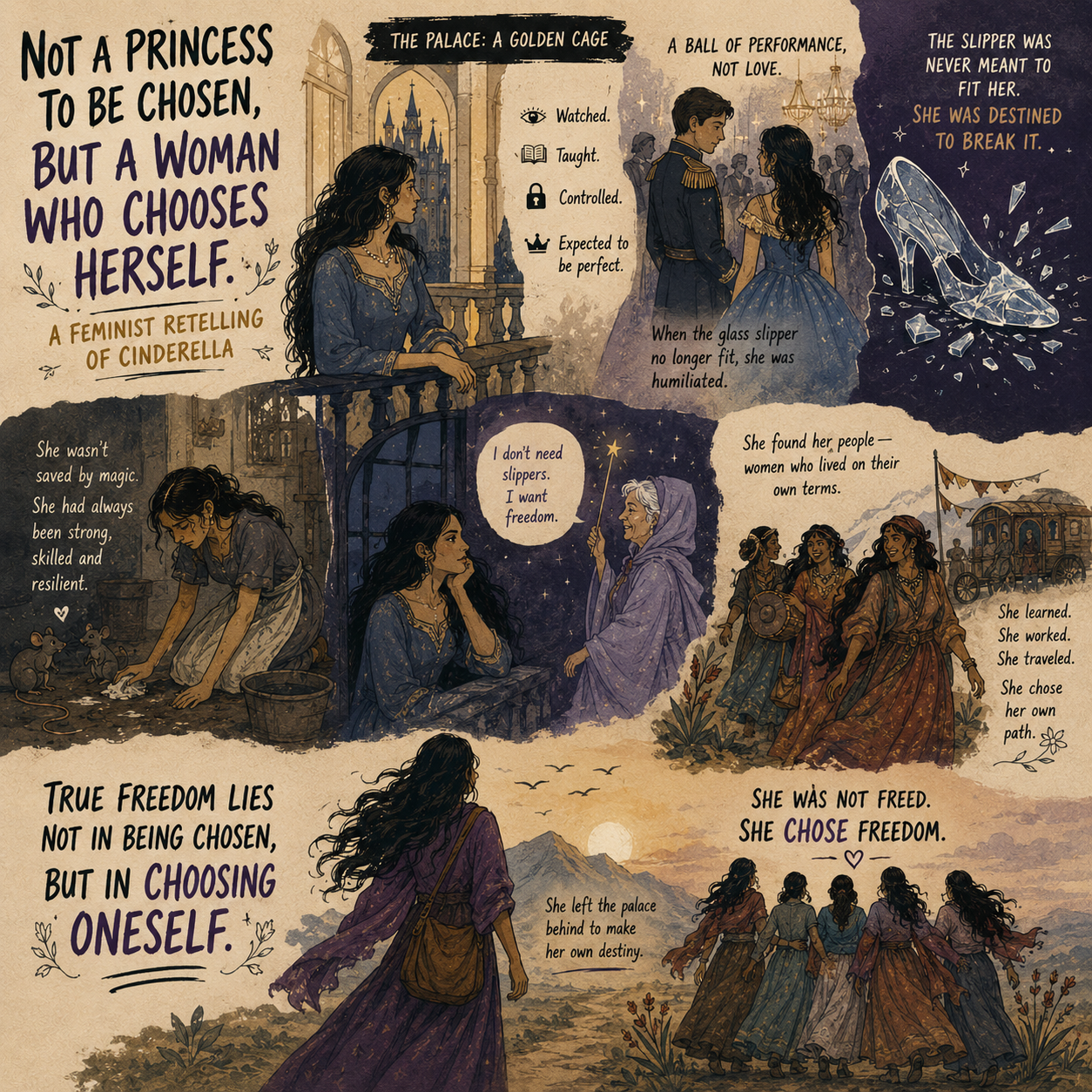
So, what if Cinderella’s story was never about being chosen, but about choosing herself? This thought became the seed of a new tale – a feminist fairytale I wove for my niece.
The Reimagined Cinderella
Cinderella married the prince. There were fireworks, royal blessings, and a honeymoon in a gilded carriage. The next morning, she awoke in silk sheets. In the royal castle, there was no chores, no scolding voices, no floors to scrub for cinderella. A silver tray of exotic fruit and fine drink awaited her bedside. She felt blessed to think how the fairy godmother and the prince had changed her life overnight.
Dressed in a velvet gown adjusted with satin ribbons and delicate lace, Cinderella wandered through the grand palace. The prince had already left for the hunt in the jungle. She spent her day idly tasting royal dishes and marveling at the vastness of her new world.
Days were passing by. The prince was perpetually occupied with hunts, politics, and courtly affairs. Cinderella, in the meantime, grew lonelier by the day. She ate alone, sang alone, unable to invite the mice or birds who once kept her company. Wherever she went, guards followed her everywhere under the guise of protection of her royal highness. But their presence reminded her that she lived under constant surveillance.
Royal tutors were assigned to her: teaching how to sit, how to walk, how to dress, how to speak. Gowns stitched tight with royal fabrics and whalebone suffocated her. High heels pained her feet. She wished to read novels, but the royal librarian dictated her reading list according to what was deemed appropriate for a princess. Slowly, she began to feel like a prisoner in a golden cage. She understood that her subjection had not ended with marriage; it had only changed its form.
A year after, the next annual ball came, Cinderella found that the grandeur no longer thrilled her as it once did. Now she saw the event’s true purpose: a political performance, a parade of alliances, wealth, and power, and the struggle of royal ladies to be chosen by a prince.
This time, at the annual ball, the prince demanded Cinderella wear the glass slippers one more time. But when he tried to slip them onto her feet, they no longer fit. Time and comfort had changed her body. Embarrassed and enraged, the prince abandoned her in front of the court. Whispers filled the hall: The glass slipper does not belong to her.
That night, Cinderella sat by her window, wondering if the prince had ever loved her at all. Or, if he only desired the owner of the glass slipper that symbolized the ideal shape of women’s body. Suddenly, the fairy godmother appeared once more, offering another magical pair. But this time, Cinderella refused. “I do not need slippers,” she said. “I want freedom.” The old woman smiled mystically and vanished.
Not long after, a caravan of wandering women, singing lively songs, passed by the palace gates. It was full of gypsy women who lived on their own terms – making pottery, selling wares, crossing borders without men’s permission. Intruiged by their songs, Cinderella began observing them in secret. Each night the caravan passed beneath her window, and Cinderella secretly met with them, learnt about their business. Eventually, she began to assist them, offering her own skills in weaving and trade. On the other hand, the prince had set off on a journey, determined to find the owner of the glass slipper who would perfectly match it. It further freed Cinderella from all her marital obligations.
One day, with courage enlightened in her mind, Cinderella left the palace behind. She joined the women in their travels, making up her own destiny. She realized that the slipper was never meant to fit her. Because she was destined to break it.
Breaking the Glass Slipper
The famous fairytale of Cinderella tells us that the prince freed her from misery. But as women, should we continue to tell a story where liberation depends on a man’s recognition?
Cinderella had always possessed strength, skill, and resilience. Years of managing her stepmother’s household proved her intelligence and capability. Why should she wait for a prince, or even a magical figure to save her? True freedom lay not in being chosen, but in choosing herself.
In this feminist retelling, the glass slipper is no longer a token of fragile beauty, but a symbol of constraint. To reject it is to reject the idea that women must conform to delicate, predetermined molds of worthiness. To break it is to step into one’s own agency.