

Research essay: Written by Imrana Rasheed
Decolonizing Epistemic Silences: Pre-colonial Baloch Literature as Counter-Archive to Western Feminist Misrepresentations
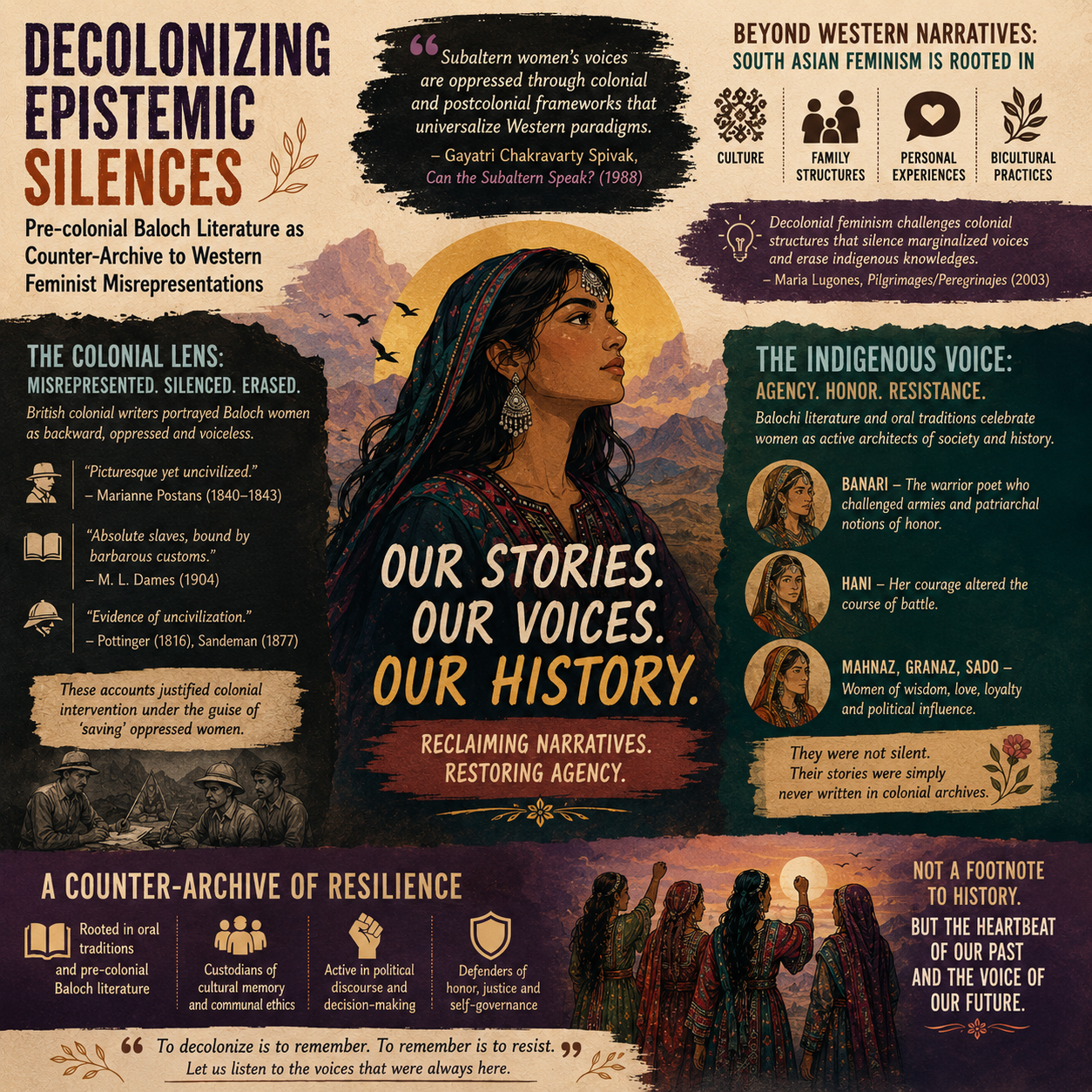
Conventionally, feminism frequently places the genesis of women’s agency within nineteenth- and twentieth-century European feminist movements. It universalizes Eurocentric narratives and marginalizes indigenous traditions and silences women's agency before the advent of institutionalized Western feminism. This Eurocentric approach perpetuates a form of epistemic violence, as explained by Gayatri Chakravarty Spivak in Can the Subaltern Speak? (1988), where subaltern women’s voices are oppressed through colonial and postcolonial frameworks that universalize Western paradigms. A colonial feminist reading of Asian women's literature challenges this hegemony, focusing on the histories of colonized nations and Asian women’s agency, their voices, and resistances, and interpreting them within their own cultural, historical, and epistemic contexts, free from the imposition of alien feminist lenses.
Chandra Talpade Mohanty, in Under Western Eyes (1984), further criticizes this universalization, insisting that “Third World women” are often stereotyped as all women from the Global South into a “monolithic Subject”: a single, homogenous category defined by their oppression, rather than recognizing their diverse historical and cultural contexts.
On the contrary, South Asian feminism does not derive from Eurocentric feminism but is a culturally defined discourse constructed by bicultural practices, family structures, and personal experiences. Maria Lugones in Pilgrimages/Peregrinajes (2003) theorizes that decolonial feminism challenges colonial epistemologies and structures that seek to silence marginalized voices into a singular cradle of modernity, progress, and emancipation. In the field of women’s studies, this approach argues that colonized societies construct their own social roles, intricate gender dynamics, and empowerment mechanisms, which were obscured by colonial discourses.
Classical Balochi literature, rooted in the oral and folk traditions of South Asia’s Baloch communities, serves as an influential counter-narrative that presents how local feminist narratives flourished independently of colonial influences and are embedded in honor codes, communal ethics, and self-governance. The Balochi literature portrays Baloch women as socially invisible entities: custodians of cultural memory, active participants in political discourse, architects of emotional decisions, and strong defenders of personal and communal honor.
Iconic figures such as Banari, Hani, Mahnaz, Granaz, and Sado are depicted not as passive archetypes but as dynamic subjects who influence socio-political, moral, and even martial outcomes. This portrayal resonates with Spivak’s (1988) notion of “strategic essentialism,” where subaltern women strategically navigate patriarchal structures to assert agency, speaking through cultural idioms that challenge their supposed silence.
To fully appreciate Baloch women’s indigenous presence and agency, it is essential to contrast it with the British colonial and stereotypical portrayal of Balochi women. European colonial historians, studying Baloch society in the nineteenth and early twentieth centuries presented Baloch women through a lens of Eurocentrism and imperial moral judgment.
Marianne Postans, in her travelogue Travels, Tales and Encounters in Sindh and Baluchistan (1840-1843), frames them within a narrative of tribal wildness, where women are part of a “picturesque” yet uncivilized society (pp. 100-102).
Mansel Longworth Dames, in The Baloch Race: A Historical and Ethnological Sketch (1904), portrays Baloch women as “absolute slaves,” bound by “barbarous customs”. He interpreted Baloch women's social position in the context of purdah taking tradition (female seclusion), marriage practices, and domestic labor, etc. He believes these practices define Baloch women’s oppressed and secondary position within a patriarchal tribal system. He also concludes that women’s condition in Baloch society is the marker of primitiveness, contrasting them implicitly with the Victorian British status of women, which reinforces colonial assumptions about European moral superiority (Dames, 1904).
Henry Pottinger, an early British traveler in 1816, and later administrators like Robert Sandeman, 1877, viewed Baloch society as barbaric and primitive, presenting women’s limited mobility and heavy labor as evidence of uncivilization rather than adaptive responses to harsh pastoral conditions. These European archives barely connect with women’s agency, oral traditions, socio-political and economic contributions, instead portraying them as passive objects of male dominance. (Pottinger, 1816; Sandeman, 1877).
These accounts served the colonial civilization mission by justifying intervention under the guise of rescuing the “oppressed” women, aligning with Mohanty’s critique of Western feminism’s complicity in imperialist narratives.
On the other hand, Balochi poetry depicts women as assertive agents refuting these colonial representations. In the Battle of Delhi in 1555 against the Suri dynasty, when the Baloch army was retreating, Banari considered it a disgrace to flee. She transcended domestic confinement, like a valor warrior, and confronted the Suri army directly. In her lines from the epic confrontation with Sheer Shah Suri:
?? ?????? ?? ?????? ?????
??? ?? ????? ?? ?????? ?????
??? ??? ????? ?? ????????
(Shad, 2016, p. 37)
“You might think that women are the ones who sit at home,
Are busy with adornment and engaging with their husbands,
But it’s not so.”
This performance embodies Banari’s invocation of social equality, challenging colonial assumptions of women’s invisibility or objectification. Her character presents an indigenous political agency rooted in Baloch sociological values, predating independence of Western feminist ideals, as Lugones (2003) describes in terms of decolonial “coalitional” gender roles.
Hani’s narrative further exemplifies emotional autonomy and defiance against patriarchal values. “Hani and Sheh Mureed is the beloved epic ballad of Balochi folklore. This tale is to Baluchistan what Romeo & Juliet is to the West” (Sarwar, 2024). Hani was the daughter of the Rind noble Mir Mandaw and fiancée of Shaymureed. Once Mir Chakar Khan Rind, the chief of the Kahiri, along with his army, was returning from hunting, stopped at the town to rest where Hani lived. Mir Chakar went to Hani, Mureed’s fiancée, who brought him clean water in a silver bowl in which she had placed a dwarf palm leaf, properly washed so that he drinks slowly and water doesn’t go down the wrong way. He drank the water with care to avoid swallowing the straw. The chief was surprised and very impressed by her intellect. He later intrigued Mureed to break up his engagement, and he got married to Hani against her will.
Chakar was successful in having Hani as her bride, but could not rule her heart.
Addressing Chakár, she asserts:
- ???? ??? ????? ?? ??? ????? ?? ?? -------------?? ???? ??? ?? ??? ?????? ?? ???” (p. 53)
“Chakár, my heart will not yield to your vows— /
It is lost, consumed by passion for that youthful sea of fervor.”
This declaration shows Hani’s refusal to submit to imposed alliances and prioritizes her “emotional truth” over tribal authority. Her persistent refusal and steadfast denial to accept Mir chakar, makes the powerful chief compelled to divorce her. Her strong agency emerges organically from Balochi traditions rather than imported ideologies.
Similarly, in the legend of Sado and Kiyya, Sado, heartbroken by her beloved Kiyya’s long and broken promise to return for their wedding, sends a poignant message compelling him to return before all hope is lost. She confronts Kiyya reveals unyielding moral fortitude:
“??? ?? ???? ?? ?? ??
??? ?? ????? ?? ???” (p. 479)
Translated: “What evil fate has befallen you?
/ That you emerge neither hidden nor revealed?”
Sado’s message demands accountability, placing her as a defender of honor and autonomy within communal narratives.
In Mahnaz’s tragic story, when she is accused of infidelity, she doesn’t acquire silence over her condition, but takes strong steps to prove her innocence. She exchanges with Shadad showcase relational assertiveness and the renegotiation of bonds. Her poetic defiance:
??? ??????? ??? ?????
??? ??? ?????? ?? ?? ?????------
?? ??? ?? ???? ?? ?? ????????
?? ?? ????? ??? ?? ?????? ----
??? ????? ?? ?? ???? ?????” (p. 4)
Translation:
“We are fig leaves, enduring on vines /
High upon mountain crests we ascend—
/ My head bows to no wind’s whisper,
/ Nor shall I bind to another’s floods— /
Yet for Shadad, new paths of light unfold.”
After proving herself innocent, she does not forgive Shahdad for staining her character, but rather declares separation:
“?? ??? ??????? ?? ?? ???? ?” (p. 3) –
“You are my honorable father and brother.”
In Baloch society, when a man split up with her wife, he declares her as her sister or mother, on contrary, Mahnaz subverting the tradition calls her husband “my honorable father and brother” (p. 3) –This reframes kinship to assert independence, resonating with Lugones’ (2020) concept of decolonial gender as negotiated coalitions rather than binary oppositions.
Cumulatively, Granaz also gives divorce to Lalla when she finds he had fled from the battleground:
“???? ??? ?????? ?? ?? ???? ?” (Shad 2006, p. 455) –
“Lalla, you are my revered father and brother” –
This story depicts that the values of social codes of ethics were equal for both men and women in Baloch society. Fleeing from the battlefield is considered a shame in Baloch society. Granaz’s decision to divorce Lalla proves she equally values the Baloch codes of ethics, and women were not the sole victim “honor”; rather, men and women both were equally accountable. It enacts a ritual of relational severance to reclaim women's agency in Baloch society.
Even maternal figures exert profound influence, as in Balach’s mother’s exhortation:
> “? ??? ?? ?????? ??????
> ???????? ?? ????? ????” (p. 208)
Translated: “O man who ignites the tribal fires ablaze,
/ Do not slumber through half-days in empty forts.”
She underscores women’s role in shaping political and moral scenarios, countering colonial views of uniform oppression of women in South Asian Muslim societies.
Baloch Women’s indigenous agency in classical poetry functions within community and kinship structures, honor codes, and social responsibilities, diverging from Western liberal feminism’s emphasis on individualistic rights. As Spivak (1999) suggests, subaltern resistance depicts strategic essentialism; here, it flourishes through oral archives that balance autonomy with relational ethics. However, decolonial feminism does not reject the presence of a male-dominant society; rather, as Lugones (2020) recognizes, patriarchy’s presence is measured without measuring it against Eurocentric benchmarks. Colonial interventions worsen these dynamics, as scholars argue that British governance and religious reinterpretations imposed strict gender boundaries absent in pre-colonial traditions. British colonization alters social roles and diminishes women’s visibility, as evidenced in Sandeman’s (1877) reports on “domestic slavery” and tribal conflicts.
The study of classical Balochi poetry enriches South Asian feminism, affirming intellectual independence and historical continuity. Decolonial feminist study unveils these archives of resistance, echoes Mohanty’s claims for plural feminisms forged locally, not with a Eurocentric approach.
In conclusion, classical Balochi literature portrays a multifaceted landscape where women navigated power, resistance, intellectual autonomy, and emotional authority within their cultural atmosphere. A decolonial feminist lens views these Baloch women’s characters not as outliers but as symbols of indigenous agency. This recognition challenges Eurocentric feminism, confirming that Asian feminist consciousness evolved along its own historical and cultural dynamics.
References
- Ahmed, A. S. (1987). Women and Gender in Islam: Historical Roots of a Modern Debate. Yale University Press.
- Dames, M. L. (1904). The Baloch Race: A Historical and Ethnological Sketch. London: Royal Asiatic Society.
- Dad, A. R.. (2014). Patan Taken Anjeer: Balochi Adabi Juhdkar Bahrain. Bahrain.
- Lugones, M. (2020). Toward a decolonial feminism. Hypatia Books
- Lugones,M (2003). Pilgrimages/peregrinajes: Theorizing coalition against multiple oppressions. Rowman & Littlefield
- Mohanty, C. (1984). Under Western eyes: Feminist scholarship and colonial discourses. Boundary 2, 12(3), 333–358.
- Pottinger, H. (1816). Travels in Beloochistan and Sinde. London: Longman, Hurst, Rees, Orme, and Brown.
- Postans, M. (1839). Travels in Western India: Including a visit to the sacred Mounts of the Jains, and the most celebrated shrines of Hindu faith between Rajpootana and the Indus, with an account of the ancient city of Nehrwalla. Saunders and Otley
- Sandeman, R. (1877). Report on the Marri and Bugti Tribes. Government of India.
- Spivak, G. C. (1999). A critique of postcolonial reason: Toward a history of the vanishing present. Harvard University Press.
- Spivak, G. C. (1988). Can the subaltern speak? In C. Nelson & L. Grossberg (Eds.), Marxism and the interpretation of culture (pp. 271–313). University of Illinois Press.
- Shad, Faqir. (1986). Miras. Balochi Academy
- Sarwar, S. (2019, March 8). Remembering the tragedy and legend of Hani and Sheh Mureed. BRANZ Baluch. https://branzbaluch.com/remembering-the-tragedy-and-legend-of-hani-and-sheh-mureed/