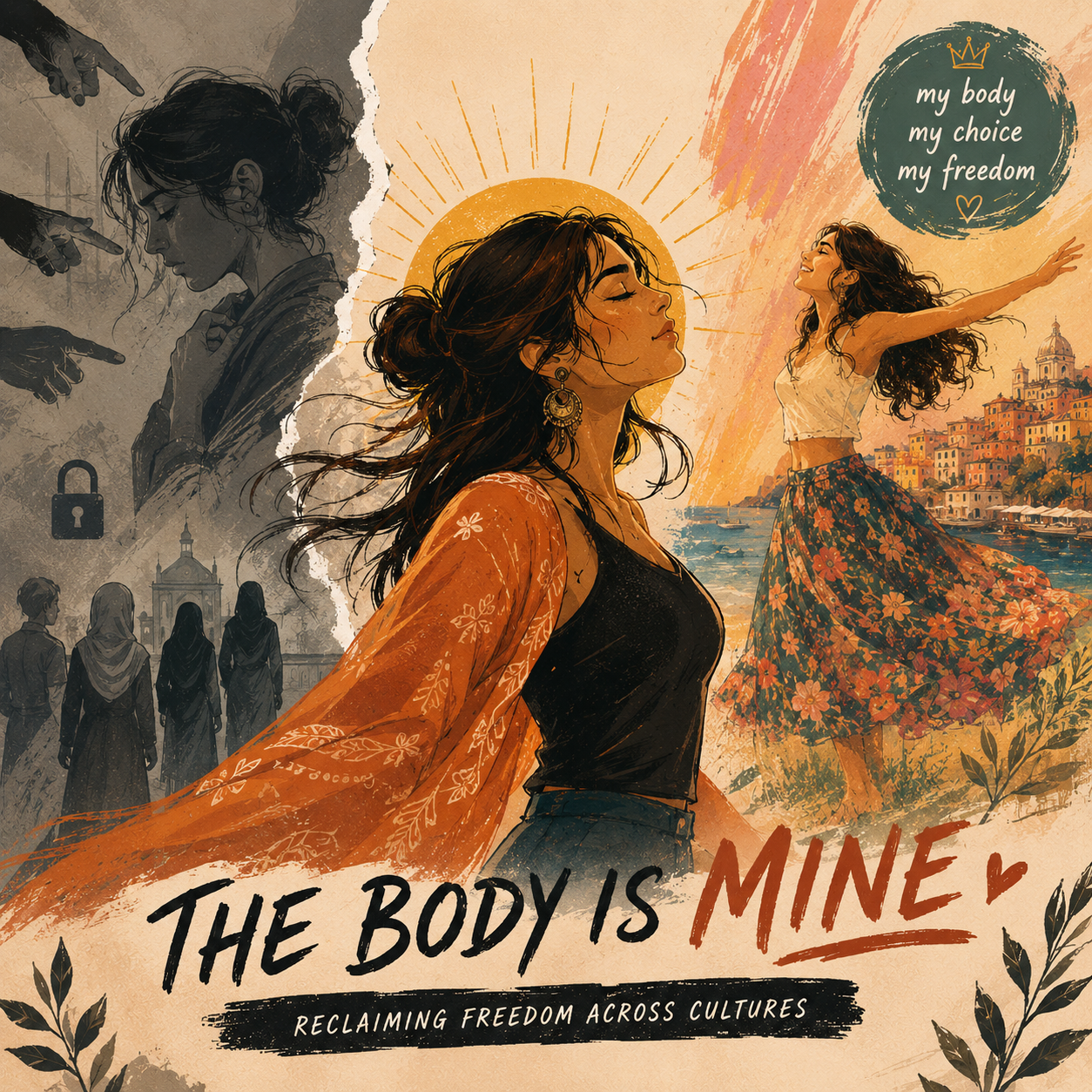
The Body Is Mine: Reclaiming Freedom Across Cultures
Urmi Hossain
The first time I was told to cover up was when I was 12 years old — the year I became a woman. Coming from a conservative and religious family, there were expectations that as a woman, you must never show a part of your body or even the shape of it.
I have dressed modestly since an early age: pants, long sleeves, and loose-fitting clothes. I never let myself wear shorts, skirts, or even show my collarbone. I thought it was normal to dress this way, but one day, as I was being dropped off at school by an uncle, my mom told me, “Cover up.” Confused and ashamed, I thought: “What exactly should I cover?”
That day, I wore pants, a t-shirt, and a cardigan. I was fully covered from head to toe. But the problem wasn't about being fully dressed, but rather being “appropriately” covered. I realized at that moment that my body could be seen even under layers of clothing. The shape of my curves, my chest — something so subtle - could become a topic of attention, judgment, and commentary in the culture I was living in.
For the first time in my life and onward, I understood that boundaries had been imposed on me from a young age — how I could dress, what I could show, and how I could express myself through my clothes and personal style. Ever since that moment, at home, at social events, or at functions, when I was around men or women, my job was to “cover up” — never give away the shape of my body. Our bodies were ultimately seen as objects of others’ desires. I used to wear long t-shirts or jackets to cover my back, or even a light scarf around my neck and chest to hide everything. This was a constant reminder from my South Asian culture that our own bodies were not ours, but meant to please or serve other people’s needs. What frustrated me the most was that even women around me would remind me to cover up, simply to avoid judgment. From a young age, I never dressed for myself. I wore clothes that reflected cultural expectations.
I also grew up in a very contrasting reality. On one hand, I lived in Italy, where it was normal to see undressed women on TV or fashion shows, almost as if they were objectified. On the other hand, I lived in a South Asian household, where the issue wasn’t just showing your body, but even giving away the shape of it. Both sides were extreme: one gave choice, the other imposed obligation.
As a young teenager, I was always curious about what it felt like to wear a skirt or a short dress — not to please others, but to find comfort in what I might enjoy.
Over time, I learned that my body wasn’t something to hide. It was others' perceptions and cultural expectations that created fear and self-awareness. Underneath those layers of clothes, there was a curiosity: what it would truly feel like to wear whatever I wanted without fear of being watched or judged.
As I grew older, I noticed how powerful choice and autonomy could be. It wasn’t about breaking rules or disobeying anyone, but about reclaiming my power over my body. I carefully selected clothes that reflected my identity, expressed my personality, and showcased my features and beauty through colors and textures.
Growing up between two cultures — Italy, where bodies are constantly displayed, and South Asia, where even a subtle curve is scrutinized — I learned that our bodies are not anyone else’s property, for anyone to control or manage. It’s about comfort and owning your presence.
As a 12-year-old who learned that our bodies were supposed to belong to someone else, I realized from that moment on that I had a choice — to reclaim my body, my presence, and my freedom. My curves, my movements, my shape are mine to honor, celebrate, and express. I can’t change the fact that I am a woman, but I can change how people think and perceive me. I’ve learned that true power isn’t in hiding, but in fully owning your space, your presence, and being comfortable in your own skin